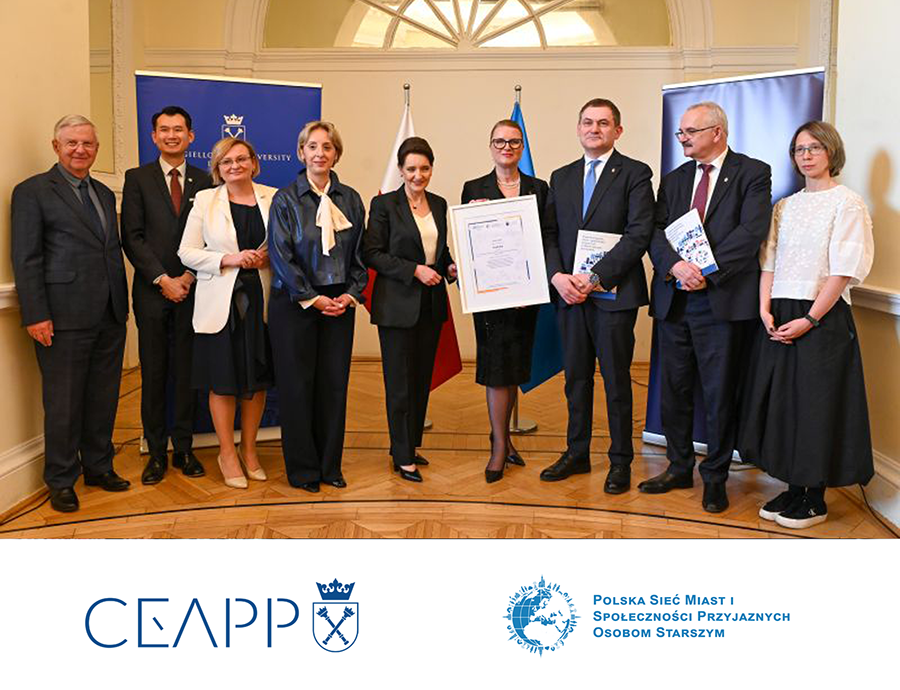
AFCC Poland supports the development, coordination and consolidation of a national network of cities and municipalities committed to creating inclusive, accessible, safe and sustainable environments for people of all ages. The network works in alignment with the framework and recommendations of the World Health Organization (WHO), promoting healthy ageing, autonomy, social participation and quality of life in older age.
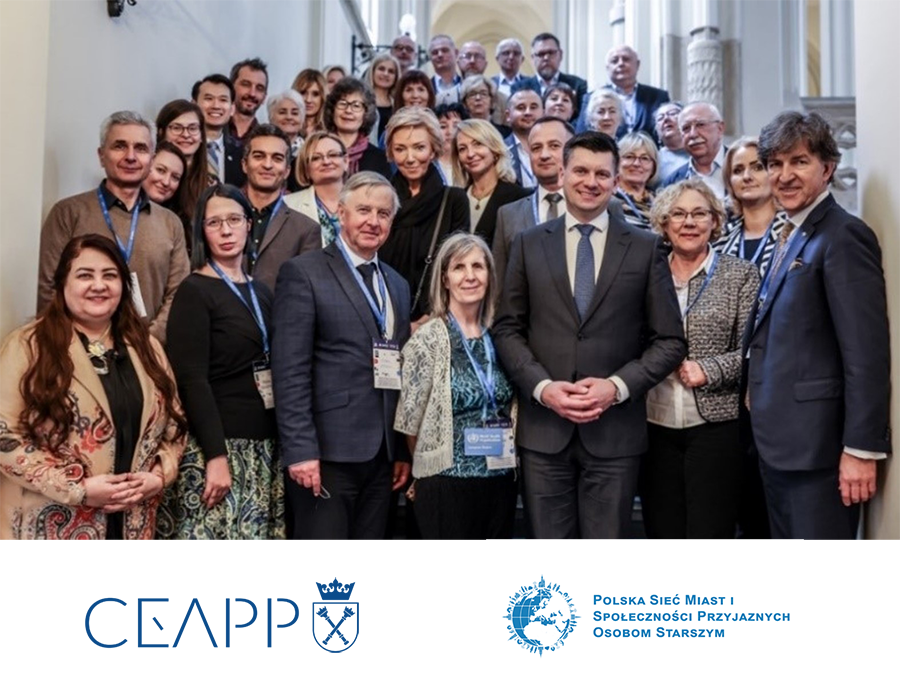
The initiative was launched following the WHO Stakeholder Consultation Meeting on National Guidelines for Age-Friendly Cities and Communities in Crisis Contexts, held in Kraków in March 2023. The meeting brought together representatives of local governments, researchers, healthcare and social policy experts, public institutions and local leaders around a shared objective: to strengthen the capacity of cities and communities to support older residents, including in crisis situations.
Since then, the network has developed into a national platform for cooperation, knowledge exchange and practical action. It connects cities and municipalities of different sizes and territorial profiles — from large metropolitan areas to smaller towns and rural communities — all working to respond to demographic change and improve quality of life for residents of all generations.
AFCC Poland is coordinated by Jagiellonian University, through the Centre for Evaluation and Analysis of Public Policies at the Faculty of Philosophy, in cooperation with Collegium Medicum. Since February 2026, Jagiellonian University has served as an affiliate partner of the WHO Global Network for Age-Friendly Cities and Communities. This affiliation strengthens AFCC Poland’s role as a national platform connecting local governments, academic expertise, public policy knowledge and international good practice in the field of healthy and active ageing.
About the network
🔹 Network name: AFCC Poland — Polish Network of Age-Friendly Cities and Communities
🔹 Coordinator: Jagiellonian University
🔹 Academic lead: Dr hab. Jolanta Perek-Białas, Prof. UJ
🔹 Team: dr hab. Jolanta Perek-Białas,Prof. U; Maria Varlamova, Prof. dr hab. med. Tomasz Grodzicki
🔹 Contact: dr hab. Jolanta Perek-Białas, prof. UJ — afccpl@uj.edu.pl, jolanta.perek-bialas@uj.edu.pl, Maria Varlamova — maria.varlamova@uj.edu.pl
Why AFCC Poland?
Poland is experiencing profound demographic change. Population ageing affects local development, public services, housing, transport, health and social care, communication, civic participation and intergenerational relations. These changes require coordinated local responses that support older people while also improving communities for all generations.
Age-friendly cities and communities recognise the diversity of older people and support their autonomy, dignity, participation and social inclusion. They aim to remove barriers in the physical and social environment and to create conditions in which older residents can continue to do what is important to them.
AFCC Poland supports local governments in translating these principles into practice. The network strengthens cooperation between cities and municipalities, promotes exchange of experience and helps connect local initiatives with national and international frameworks for healthy ageing.
The network is also attentive to crisis contexts and to the needs of groups at risk of exclusion, including older refugees and migrants. This perspective reflects the origins of the network and its focus on resilience, inclusion and local preparedness.
What do we aim to achieve?
AFCC Poland aims to strengthen cooperation between cities and municipalities working to become more age-friendly and to create a stable national platform for exchange, learning and joint development.
The network seeks to promote healthy ageing and inclusive local policies, support the implementation of age-friendly solutions, and strengthen the capacity of local governments to respond to demographic change, social change and crisis situations. It also aims to improve the visibility of Polish local initiatives in the international age-friendly movement and to connect Polish cities and municipalities with the WHO Global Network for Age-Friendly Cities and Communities.
AFCC Poland also aims to expand the reach of the age-friendly movement in Poland by encouraging more cities and municipalities to engage in the network and by supporting those interested in joining the WHO Global Network for Age-Friendly Cities and Communities.
A central objective of AFCC Poland is to combine local experience, academic expertise, public policy knowledge, the voices of older people and international good practice. This combination allows the network to support evidence-informed, participatory and context-sensitive approaches to local senior policy.
How do we work?
AFCC Poland functions as a platform for regular exchange, coordination and mutual learning between cities and municipalities. Its activities include regular network meetings, thematic consultations, webinars, workshops, stakeholder meetings and, where possible, study visits supporting practical learning and exchange between cities and municipalities in Poland and abroad.
The network supports cities and municipalities in identifying local needs, documenting age-friendly initiatives, exchanging good practices and developing policies that respond to demographic change. Particular attention is given to the experiences of Polish local governments, including their actions for older residents, older refugees and other groups at risk of exclusion. AFCC Poland also prepares information and communication materials presenting the work of the network and the distinctive initiatives developed by member cities and municipalities.
In line with its participatory approach, AFCC Poland promotes activities and publications that reflect the voices and experiences of older people themselves. This includes documenting local perspectives, community experiences and the challenges faced by older residents, including older refugees, in order to strengthen awareness among local authorities and other stakeholders.
AFCC Poland cooperates with key institutional partners, including the WHO Office in Poland, the Ministry of Health, the Government Plenipotentiary for Senior Policy, and other stakeholders involved in healthy ageing, social policy and local development.
The network also promotes the use of data, research and evaluation in local senior policy. This includes encouraging cities and municipalities to monitor their activities, assess local needs and develop practical tools for planning, implementation and evaluation.
Expected results
For local governments, AFCC Poland provides a structured platform for cooperation, access to knowledge, exchange of experience, consultation support, assistance in applying to the WHO Global Network for Age-Friendly Cities and Communities, and practical resources for developing age-friendly policies.
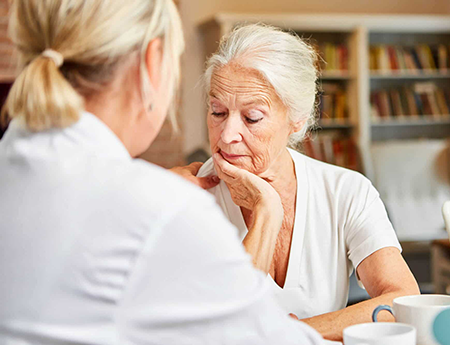
For older residents, including older people at risk of exclusion, the network contributes to better local environments, improved access to services, stronger social participation and greater recognition of their needs, rights and contributions.
For older refugees and migrants, AFCC Poland supports the visibility of their experiences and promotes local responses that strengthen inclusion, access to information, social support and community participation.
For public administration and policymakers, AFCC Poland offers a source of evidence, local experience and policy recommendations relevant to ageing, social inclusion, health, care, accessibility, crisis preparedness and local resilience.
For society as a whole, the network promotes a broader understanding of ageing as a shared social process and supports the development of communities that are more inclusive, accessible and sustainable for all generations.
Read also:
Ekspertyzy - Centrum Ewaluacji i Analiz Polityk Publicznych - Wydział Filozoficzny